You made an AI video. You posted it. Three likes — two from your own accounts. The problem usually isn't the tool you used or how long it took to generate. It's what you put into the prompt and how you thought about the video before you made it.
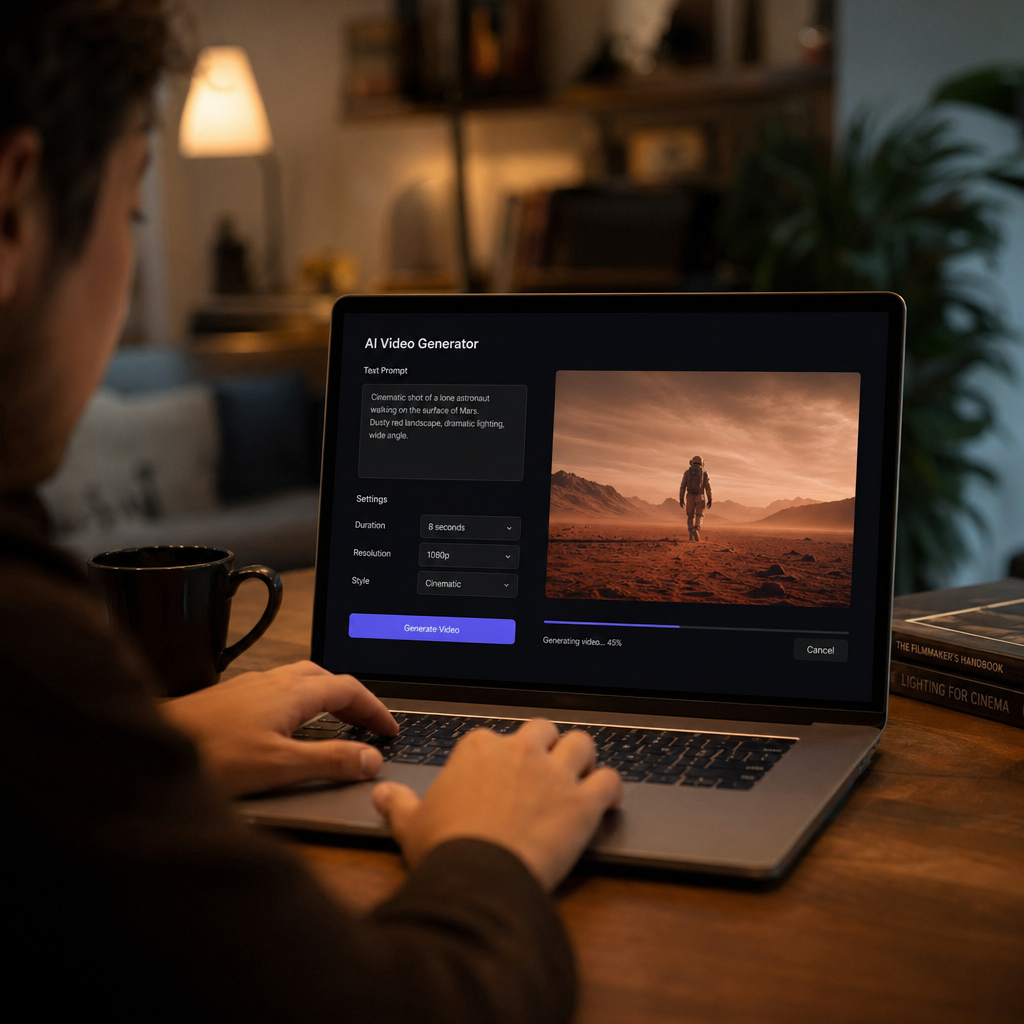
Quick answer: To make an AI video that gets shared, lead with a visual hook in the first 2 seconds, keep it under 15 seconds, and build around one surprising or specific idea. Technically impressive isn't the same as shareable. The concept does the work — the video just delivers it.
What Makes an AI Video Shareable in the First Place
Shareability is almost never about production quality — it's about whether someone immediately wants to show another person. Ask yourself: does this video make someone say "you have to see this"? If the answer requires explanation, the video probably won't spread on its own.
The videos that move through feeds fastest share a few traits: they're immediately legible (no setup required), they're surprising in a specific way, and they work without sound. That last one is underrated. Most people scroll with audio off. If your video only lands with music or voiceover, you've already cut your reach significantly.
How to Write a Prompt That Produces Distinctive Visuals
Generic prompts produce generic videos — the single biggest reason AI-generated content disappears into the feed. "A sunset over the ocean" is a prompt. "A cargo ship breaking through a flat mirror horizon at golden hour, reflections fracturing in every direction" is a concept. The second one generates something people haven't seen before.
A few prompt techniques that consistently produce shareable visuals:
- Anchor to a specific place and time. "A bodega in the Bronx at 6am" beats "a small store in the morning."
- Add one physically impossible element. Not gratuitously weird — just one thing that couldn't happen in the real world. A subway car filling with water. A skyscraper growing upward in real time.
- Describe the camera, not just the subject. "Close on hands sorting through old photographs, slow pull back to reveal an empty room" gives you movement and mood, not just a static image that happens to be moving.
Example prompt: "A woman walks through a crowded market in Marrakech. As she passes each stall, the colors drain from the fabric, leaving everything grey behind her. Shot at eye level, handheld, midday light."
That's specific enough to generate something distinctive. Try it at atxp.video/chat.
The 2-Second Rule for Hooks
The first 2 seconds determine whether anyone watches the rest. On TikTok, Instagram Reels, and X, a viewer's finger is already moving before the video has had time to establish anything. Your most visually striking frame needs to be the opening frame — not a buildup to it.
This changes how you think about prompts. Instead of describing a scene that develops toward something interesting, describe the interesting thing happening immediately. Put the impossible element, the unexpected perspective, or the most saturated visual up front. If your concept has a "reveal," consider whether the reveal could just be the whole video — compressed into 8 seconds instead of 30.
Short, loopable videos also have a structural advantage: they accumulate watch time because people rewatch them trying to figure out what they just saw. That behavior signals algorithm promotion on nearly every platform.
Format Your Video for the Platform Before You Generate It
Different platforms reward different dimensions and lengths, and making a video for the wrong format costs you reach before anyone sees it. A widescreen cinematic video that would land on YouTube is a poor fit for TikTok or Instagram Stories. Know where you're posting before you write the prompt.
| Platform | Ideal Aspect Ratio | Sweet Spot Length | |---|---|---| | TikTok | 9:16 vertical | 7–15 seconds | | Instagram Reels | 9:16 vertical | 7–15 seconds | | X (Twitter) | 16:9 or 1:1 | 10–30 seconds | | YouTube Shorts | 9:16 vertical | 15–30 seconds | | LinkedIn | 1:1 or 16:9 | 15–30 seconds |
Think about this before generation, not after. Cropping a cinematic horizontal video into a vertical format rarely works — important elements end up cut out, and the composition falls apart.
One Idea Per Video, Executed Completely
The videos that get shared are almost always built around a single clear concept — not a montage of impressive moments. It's tempting to pack in multiple scenes or ideas, especially when generation is fast. Resist it.
A single specific idea, fully committed to, beats a reel of loosely connected visuals every time. "A timelapse of a city block being reclaimed by jungle over 100 years, shot from the same fixed angle" is one idea. It has a clear beginning, middle, and end. The viewer knows exactly what they're watching and why it's interesting — and they can describe it to someone else in one sentence. That one-sentence describability is what actually drives sharing.
Build around concepts you could explain in under 10 words. If it takes a paragraph to set up why it's cool, the video will require that same paragraph — and you can't attach a paragraph to a share.
Test More Concepts, Spend Less Per Test
One of the real advantages of pay-per-video pricing is that you can generate 10 different concepts for the cost of a single subscription month elsewhere. Most creators settle on an idea and commit to it. The ones whose content consistently spreads treat each video as a hypothesis and test multiple angles of the same concept.
Make the rainy-Tokyo version. Make the Mojave-Desert version. Make the version where the impossible element is subtle and the version where it's the entire point. You'll know within 48 hours of posting which direction is worth developing further.
No subscription required. ATXP Video is pay-per-video — add a balance, generate what you need, and your balance never expires. Start at atxp.video/chat.
Runway starts at $15/month before you've made a single video. Sora requires a $20/month ChatGPT Plus subscription. If you're testing concepts rather than running a production pipeline, paying per video makes more practical sense than committing to a monthly fee.
What Actually Works: The Short Version
If you want to know how to make AI video go viral, the answer isn't a better tool or a longer prompt — it's a sharper idea delivered in the first 2 seconds, formatted for the platform where it'll live, and built around one concept someone can describe to a friend. Generate variations. Cut what doesn't land. Double down on what does.
Describe the video you'd want to stop scrolling for. Start at atxp.video/chat.